Just got the keys to your new home in Manor Lakes, Tarneit, Mambourin or Fraser Rise? Before you order turf or book a landscaper, check your estate's design guidelines. Most new estates in Melbourne's western and northern growth areas have strict rules for front yards, and getting them wrong can mean redoing the work or missing out on your developer's landscaping rebate or bond.
We landscape front yards in new estates across Wyndham, Melton and Hume every month, and the same questions come up again and again. This guide explains the rules you're most likely to see, what's usually banned, and how to meet the requirements without overspending.
Quick answer: Many new Melbourne estates require at least 50–60% of the front yard to be soft landscaping (garden beds, trees and natural turf), at least one tree of around 2m at planting, and natural mulch. Synthetic grass, loose gravel and toppings are often banned in front yards. Always check your own estate's design guidelines, as rules vary.
Why Do New Estates Have Front Yard Rules?
Developers want streets to look green, consistent and finished, which protects property values for everyone in the estate. That's why your land contract usually includes Design Guidelines (sometimes called a Memorandum of Common Provisions or Building Envelope rules). Plans are often checked by a Design Review Panel (DRP) before building, and some estates ask for a front landscape plan as part of that approval.
Many estates also set a deadline, often within 6–12 months of moving in, for the front yard to be finished. Some offer a landscaping rebate or return a bond once it's completed to the approved plan.
The Most Common Front Yard Rules
Every estate is different, but these are the requirements we see most often in western and northern Melbourne estates:
Rule | What it usually means |
|---|---|
Minimum soft landscaping | 50–60% of the front yard must be garden beds, trees, ground covers and natural turf. Driveways and paths count as hard surfaces. |
At least one tree | One or more advanced trees, often at least 2m high at planting (commonly a 45L or 75L pot size). |
Natural mulch | Garden beds mulched with natural bark or organic mulch. Stone mulch may only be allowed in small areas. |
Dense planting | Plants close enough that very little mulch is visible within about two years. |
Water-wise design | Drought-tolerant plants and drip irrigation encouraged. |
Hard surfaces limited | Only essential driveways and paths. Extra paving or concrete in the front yard is often not allowed. |
Letterbox standards | Letterboxes that match the house materials (e.g. brick, render, timber or metal). Single-post letterboxes are often not permitted. |
What's Often Banned in Front Yards
Synthetic grass: many estates prohibit it in the front yard, even if it's fine in the backyard.
Crushed rock, gravel, Tuscan or Lilydale toppings for paths or driveways.
Large areas of pebbles or stone mulch instead of planted garden beds.
Extra hard surfaces such as wide concrete areas or stepping-stone paths that push you below the minimum garden percentage.
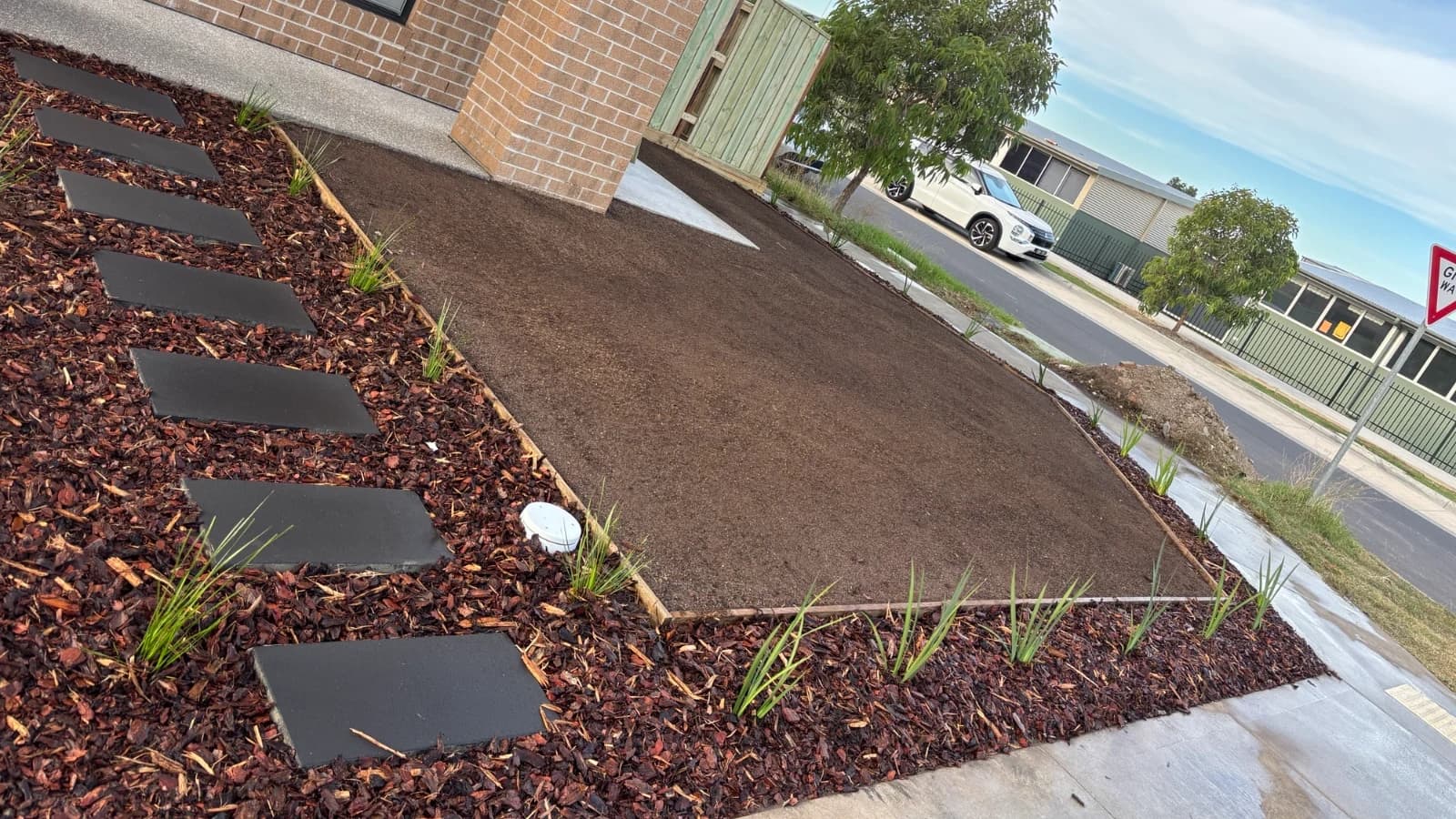
Watch out for "inspiration" photos. A design with a stepping-stone path and lots of hard surfaces might look great online, but it may not meet your estate's minimum garden percentage. Check the numbers before you commit.
How to Check If Your Design Complies
Most approved landscape plans include a small table like this. Here's a real example from a recent Manor Lakes front yard we quoted:
Area | Size | % |
|---|---|---|
Front garden area (turf + garden beds) | 45.90m² | 61.13% |
Driveway & path | 29.19m² | 38.87% |
Front yard total | 75.09m² | 100% |
With a 60% minimum, this design passes, but only just. Adding even a small path or paved area would drop it below the limit. That's why we always work from your approved plan and don't add hard surfaces that aren't on it.
How Much Does Estate Front Yard Landscaping Cost?
For a typical new-estate front yard of around 40–50m² of garden area, here's what homeowners in Melbourne's west are paying in 2026:
Option | What's included | Typical cost (inc GST) |
|---|---|---|
Basic | Site prep and soil, natural turf, garden beds with bark mulch. You supply and plant your own plants. | $3,000 – $4,000 |
Complete to plan | Basic, plus edging, all plants, advanced feature trees and planting | $7,000 – $9,000 |
Complete plus extras | Complete, plus drip irrigation and low-voltage garden lighting | $10,000 – $12,500 |
Prices depend on your block, soil condition, the plant list on your approved plan and tree sizes. Natural turf such as Sir Walter buffalo typically costs around $60/m² supply and lay.
Ways to save without breaking the rules
Plant it yourself: have a landscaper do the heavy work (prep, soil, turf, mulch), then buy and plant the plants on your plan yourself.
Choose smaller pot sizes for shrubs (e.g. 140–150mm). Just keep the planting dense.
Stick to the approved species list. Changes may need DRP approval, which costs time.
Do the front and back together: one site setup and one delivery usually works out cheaper.
Order of Works: Driveway First
In most estates the driveway, path and porch are done by the homeowner (or their concreter) after handover. Get the concrete done before the landscaping, so edging, soil levels and turf finish neatly against it. Doing it the other way round often means damaged turf and redone edges.
Our Tips Before You Start
Find your Design Guidelines in your land contract or on the developer's website, and note your completion deadline.
Get your approved landscape plan, including the area table and plant list.
Check the rebate or bond conditions: some developers need photos or an inspection to release it.
Ask your landscaper to quote to the plan, and to point out anything that won't comply.
Plan your watering: new turf and plants need regular water for the first few weeks, so consider drip irrigation for garden beds.
Need Help With Your Estate Front Yard?
K&M Gardening & Landscaping is based in Wyndham Vale and landscapes new-estate front yards across Manor Lakes, Tarneit, Mambourin, Werribee, Fraser Rise and surrounding suburbs. Send us your approved plan and we'll give you a clear, itemised quote that follows your estate's rules, with options to suit your budget.
Call Keval on 0485 512 240 or request a free quote online. See our turf installation and landscape design services.
Frequently Asked Questions
Can I have synthetic grass in my front yard in a new estate?
Many new Melbourne estates don't allow synthetic grass in the front yard, though it's usually fine in the backyard. Check your estate's design guidelines before you buy.
What percentage of my front yard needs to be garden?
It varies by estate, but 50–60% soft landscaping (garden beds, trees and natural turf) is common. Your approved landscape plan will usually show the exact percentage.
How tall does the front yard tree need to be?
Many estates require at least one tree that's around 2m high at planting. Advanced trees in 45L or 75L pots usually meet this. Confirm the height with your supplier before delivery.
Can I use pebbles or gravel instead of mulch?
Often not. Most guidelines require natural bark or organic mulch in garden beds, and ban crushed rock, gravel and toppings for paths. Some allow stone mulch over a small area only.
How long do I have to finish my front yard?
Many estates set a deadline, often 6–12 months after you move in, to qualify for a rebate or bond return. Check your land contract or contact your developer.
Can I do the planting myself to save money?
Yes. A popular option is to have a landscaper handle site prep, soil, turf and mulch, then plant the approved plants yourself. Just make sure the finished yard still matches your approved plan.
Get a Free Landscaping & Construction Quote
K&M Gardening & Landscaping delivers premium outdoor construction engineered for Melbourne conditions. Free site visits and upfront itemised pricing.
Get Your Free Quote